Your team has approval to test the China market. You have a campaign concept, potential creators, and an English-language landing page ready for translation. Sales wants inquiries sent directly into Salesforce or HubSpot. Leadership wants to know when the campaign can launch.
Then the questions start.
Can we use the same product claims we use in the United States? Will the content pass platform review? Can customer information go into our U.S. CRM? Does our existing privacy notice cover this campaign?
China marketing compliance should be part of those early planning conversations—not something the team checks after the creative is finished.
For U.S. brands, the review involves three separate areas: campaign content, advertising claims and disclosures, and customer-data handling. China’s Advertising Law, internet advertising measures, and Personal Information Protection Law address different parts of that work.
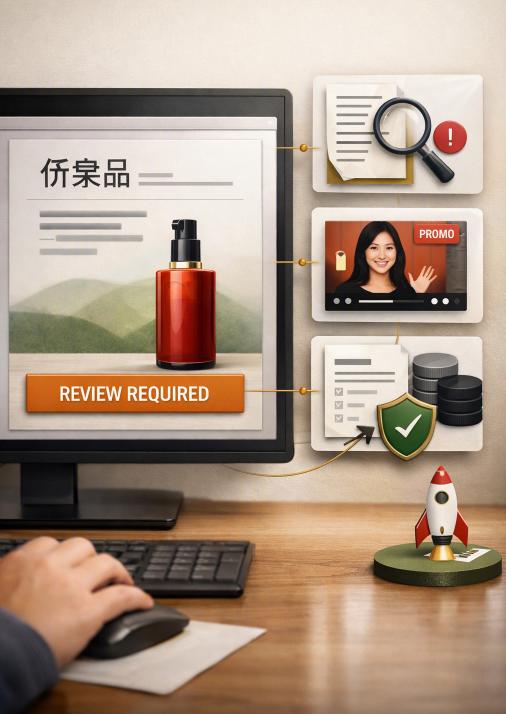
This guide explains the questions to raise, the everyday marketing situations they affect, and where specialist review belongs.
Everyday marketing scenarios in this article are hypothetical. The enforcement examples are based on the linked Chinese-language reporting about a SAMR announcement, rather than direct links to the original enforcement decisions. English explanations are summaries, not official translations.
Start With the Campaign
What should a U.S. marketing team review before launching in China?
Start with the campaign you actually plan to run—not a generic checklist of every regulation that might exist.
A creator campaign directing shoppers to a product page raises different questions from a university collecting student inquiries or a B2B company promoting a downloadable report.
Use these five questions to organize the review.
| Question | What your team should examine |
|---|---|
| What are we saying? | Product claims, comparisons, testimonials, imagery, and campaign concepts. |
| How is the promotion presented? | Advertising identification, creator content, and platform requirements. |
| What information are we collecting? | Inquiry fields, registration details, analytics, and tracking. |
| Where does that information go? | CRM connections, storage, international transfers, and vendor access. |
| Who approves the work? | Marketing, localization, legal, privacy, technical teams, and partners. |
The purpose is to find the issues that affect your campaign before production and media commitments make changes expensive.
Advertising Claims
Can we reuse our U.S. advertising claims in China?
Do not assume that translating approved U.S. copy makes it ready for China. China’s Advertising Law requires truthful advertising, prohibits false or misleading content, and restricts specified absolute wording. Some product and service categories have additional requirements. See Articles 4 and 9 of the Advertising Law.
A familiar situation: your best-performing ad needs localization.
Imagine you manage a U.S. skincare brand. Your strongest campaign calls a product “the best solution for sensitive skin,” includes customer testimonials, and promises noticeable results.
Your team wants to translate the campaign because it already performs well at home.
Before producing the Chinese version, review:
- What each claim actually promises.
- Whether the supporting evidence matches that promise.
- Whether the Chinese wording changes or strengthens the meaning.
- Whether the product category has additional advertising restrictions.
- Whether creator scripts repeat or expand the claims.
Treat phrases such as “the best,” “guaranteed,” or “number one” as review flags—not as interchangeable wording that can move unchanged between markets. These phrases do not necessarily fall under the same legal rule. Qualified advisors should assess the wording, evidence, product category, and context.
What to do before production.
Create a claims sheet containing the original copy, supporting evidence, proposed Chinese wording, and approval status.
That gives your localization team and creators a shared reference. It also reduces the chance that an approved statement becomes a stronger, unsupported promise during translation or filming.
Real Enforcement Examples
What can happen when a China campaign crosses the line?
In October 2026, Chinese-language media reported on cases included in an advertising-enforcement announcement by China’s State Administration for Market Regulation, commonly called SAMR.
These are advertising-enforcement examples—not documented cases of a platform rejecting a translated U.S. campaign. They show how creative tone, imagery, and promotional framing can attract regulatory scrutiny independently of translation quality.
The cases below were reported as part of SAMR’s October 13, 2026 roundup. That announcement date is separate from the dates on which local authorities imposed the penalties.
| Campaign | Reported issue | Reported outcome |
|---|---|---|
| Dettol clothing-disinfectant campaign | Reporting described advertising that objectified women through discriminatory gender-related messaging. | In September 2026, Shanghai Manlun Trading Co. (上海曼伦商贸有限公司) was fined RMB 800,000. Guangxi Shunshi Information Technology Co. (广西瞬视信息科技有限公司) received fines and confiscation totaling RMB 265,000. Reporting on SAMR’s announcement (Chinese) |
| Shuke tooth-whitening patch video | Reporting described a promotional video using sexually suggestive wording that authorities found contrary to public order or good social customs. | In September 2026, Guangzhou Tangshiyi Trading Co. (广州唐十一商贸有限公司) was fined RMB 500,000. Reporting on SAMR’s announcement (Chinese) |
| AI-generated nurse-themed bar promotion | Reporting described an AI-generated poster featuring sexualized nurse imagery and “uniform party” messaging. Authorities found the promotion contrary to public order or good social customs. | In June 2026, Quzhou Aipaike Bar Co. (衢州爱派客酒吧有限公司) was fined RMB 300,000. Reporting on SAMR’s announcement (Chinese) |
English company names are translations or transliterations. The Chinese names identify the entities named in the reporting. These links lead to media coverage, not directly to SAMR’s original notice or the underlying administrative decisions.
What U.S. marketing teams can learn.
- Review gender portrayal and relationship framing, not only product claims.
- Examine innuendo and “edgy” copy in the context of the intended market.
- Review AI-generated visuals as carefully as photography or conventional illustrations.
- Identify the parties responsible for designing, approving, and publishing the advertising.
These cases concern reported enforcement under China’s Advertising Law. They do not establish that every similar creative choice will produce the same outcome. The facts, industry, and applicable requirements matter.
Separate the Review Areas
Is content censorship the same as advertising compliance?
No. Content restrictions, advertising requirements, platform decisions, and privacy obligations should not be treated as interchangeable.
Advertising rules address matters such as truthfulness, prohibited claims, and whether promotional material is recognizable as advertising. Privacy rules address the handling of personal information. Neither is a complete explanation of every content restriction a campaign might encounter. Compare the internet advertising measures with PIPL.
For planning purposes, separate the review into:
- Content and platform review: Is the concept appropriate for the intended publishing environment?
- Advertising review: Are the claims, imagery, and promotional presentation acceptable?
- Privacy review: Is the customer-data journey properly assessed?
- Cultural review: Will the audience understand the message as intended?
A campaign can need changes for more than one reason. Asking a reviewer simply to “check whether it is censored” is too broad to produce a useful approval.
Personal Information
Does PIPL apply if our company is based in the United States?
It can. Article 3 of China’s Personal Information Protection Law extends its scope to certain processing outside China, including processing intended to provide products or services to individuals in China or to analyze or evaluate their behavior. A U.S. business address does not automatically place an activity outside the law. Read Article 3 of PIPL.
A familiar situation: every inquiry enters the same marketing workflow.
Your company may use a standard setup:
Campaign → Landing page → Inquiry form → U.S. CRM → Email follow-up
For a China-facing campaign, your team needs to understand what happens at every step.
The form might collect a name, email address, phone number, company, or program interest. Analytics tools may collect additional information. An agency might access submissions before they reach sales.
The practical starting point is a data map—not an assumption that your existing workflow is automatically suitable.
Questions for marketing operations.
- Which fields are necessary for the inquiry?
- What tracking tools run on the page?
- Which organization collects the information?
- Where is it stored and processed?
- Which vendors and team members can access it?
- Does the person enter additional marketing sequences?
- How will applicable notices, consent requirements, retention periods, and rights requests be handled?
PIPL establishes principles including clear purpose, necessity, transparency, and limiting collection to the minimum scope needed. It also sets out permitted grounds for processing and notice requirements. See Articles 5–7, 13, and 17 of PIPL.
Do not reduce the review to adding a checkbox. The information collected, stated purpose, follow-up activity, and actual system behavior need to fit together.
Cross-Border Data
Can leads from China go into Salesforce or HubSpot in the U.S.?
There is no universal answer based solely on the CRM’s name. Assess the information involved, the organizations handling it, and whether the workflow creates a cross-border transfer.
China’s cross-border data rules include different transfer mechanisms and exemptions. The CAC’s provisions distinguish personal information and important data from other information.
For example, Article 3 addresses overseas transfers of data generated through activities including multinational marketing when that data contains neither personal information nor important data. Read the CAC’s Provisions on Promoting and Regulating Cross-Border Data Flows.
A familiar situation: “It is only a short contact form.”
A short form can still collect personal information. Before connecting it to your U.S. CRM, ask your privacy advisors to review:
- What information is being transferred.
- Whether sensitive personal information is involved.
- Who receives or accesses it.
- What notices, consent requirements, and assessments apply.
- Whether a transfer mechanism or exemption applies.
Distinguish customer-level records from other reporting. A campaign summary and a spreadsheet containing identifiable leads are not necessarily the same data category.
An exemption from a specified transfer mechanism does not mean the entire activity is exempt from personal-information protection obligations. Assess the CAC provisions alongside applicable PIPL duties.
Creator Campaigns
Do creator reviews need to be identified as advertising?
Promotional content does not automatically fall outside advertising rules because it looks like an informal review.
Article 9 of China’s Measures for the Administration of Internet Advertising addresses promotions using formats such as knowledge sharing, experience sharing, or consumer reviews. Where these promote goods or services and include shopping links or other purchase methods, the provision calls for prominent advertising identification, except where publishing the advertising is itself prohibited. See Article 9 of the internet advertising measures.
A familiar situation: the creator wants the post to feel natural.
A creator proposes a product review with a purchase link. Your team likes the concept because it feels less scripted than a conventional advertisement.
That creative approach does not settle the disclosure question.
Before approving the post, agree on:
- How its advertising nature will be identified.
- Which claims the creator may make.
- Who approves the script and final content.
- How revisions or corrections will be handled.
- Which platform-specific requirements apply.
The goal is not to make every creator post sound identical. It is to establish clear boundaries before content goes live.
Websites and Hosting
Does a Chinese-language website need an ICP filing?
Language alone does not determine the answer. A website hosted in mainland China generally requires an Internet Content Provider filing, commonly called an ICP filing. A filing and an ICP license are different, and the relevant requirements depend on the online activity. Cloudflare’s China Network ICP documentation explains the distinction for website hosting.
A familiar situation: “Our website already works—can we just translate it?”
Your existing site may use embedded video, third-party forms, analytics scripts, live chat, and a scheduling tool.
Before sending campaign traffic to it, arrange a technical review of the intended customer journey:
- Can visitors load the page and its important resources?
- Does the inquiry form submit successfully?
- Is the confirmation message clear?
- Does follow-up reach the correct team?
- Are hosting and registration questions resolved?
Review technical accessibility, hosting requirements, and personal-information handling separately. Translation does not answer all three.
Review Responsibilities
Who should approve a China marketing campaign?
Marketing should coordinate the process, but it should not be expected to replace legal, privacy, or technical specialists.
A suggested division of responsibility looks like this:
| Team | Primary review responsibility |
|---|---|
| Marketing | Audience, objective, offer, message, and customer journey. |
| Localization | Language, context, terminology, and customer understanding. |
| Legal or regulatory advisors | Claims, agreements, and applicable advertising requirements. |
| Privacy and marketing operations | Forms, tracking, CRM connections, data flows, and vendor access. |
| Technical team | Hosting, accessibility, integrations, and conversion testing. |
| Agency and creators | Deliverables, approved messaging, publishing requirements, and revisions. |
A familiar situation: legal review arrives two days before launch.
The media is booked. The creator has filmed. Sales is expecting leads.
Then the team discovers that a claim needs revision or the form workflow requires further review.
Agree on review responsibilities before production. Give reviewers the planned campaign, claims, data flow, and publishing format early enough to influence the work.
Before You Go Live
China marketing compliance: pre-launch checklist.
Before approving the launch, confirm that your team has:
- Documented the campaign objective and intended audience.
- Reviewed Chinese-language claims against supporting evidence.
- Reviewed creative direction, imagery, and cultural context for the intended market.
- Established content and platform approval responsibilities.
- Agreed on creator advertising identification and permitted claims.
- Mapped forms, tracking, CRM connections, and vendor access.
- Assessed applicable privacy notices and processing requirements.
- Reviewed international personal-information transfers.
- Checked hosting and registration considerations.
- Tested the path from campaign click to inquiry or purchase.
- Assigned owners for corrections, complaints, and follow-up.
Use the checklist to organize specialist review—not as a substitute for it.
FAQs
Frequently asked questions.
Does platform approval mean a campaign is legally compliant?
Do not treat platform approval as a complete compliance sign-off. Maintain your own review process for advertising claims, promotional identification, personal information, and agreements. These areas involve distinct requirements.
Can we translate our U.S. privacy notice for a China campaign?
Translation may be part of the work, but it is not the whole assessment. Review whether the notice accurately describes the activity, information collected, purposes, recipients, and international data flows, and whether it addresses applicable PIPL requirements.
Does all marketing data have to stay in China?
Do not make that assumption. China’s cross-border data rules distinguish different data and transfer circumstances and provide specified exemptions. Determine which requirements apply to the actual workflow rather than treating all marketing reporting and customer information alike.
Are advertising penalties the same as platform rejection?
No. A platform may reject or request changes to an advertisement during its review process. Regulatory enforcement can involve a separate investigation and penalties. The cases discussed in this article concern reported enforcement actions, not documented pre-publication platform rejections.
Should we wait until the campaign is finished to request legal review?
No. Build review into planning before claims, creator scripts, forms, and integrations are finalized. This gives the team time to make changes without disrupting production or launch commitments.
For the underlying requirements, consult PIPL, the CAC cross-border data provisions, and the internet advertising measures with qualified advisors.
Plan Before You Launch
Build the review into your China marketing plan.
The most useful question is not “Can we market in China?” It is “What does this particular campaign need to be ready?”
Start with the content, customer journey, and tools your team intends to use. Identify the questions that need specialist input, assign owners, and resolve them before committing to production and media.
For the broader planning process, read How U.S. Brands Can Enter the China Market: A Practical Marketing Guide .
Explore Janalyssa’s China digital marketing services for help with market-entry planning, localized content, and campaign coordination.
Janalyssa supports marketing planning and execution. Legal, regulatory, and privacy decisions should be reviewed by qualified advisors.
This article provides general marketing-planning information, not legal advice. Requirements depend on the activity, industry, information involved, and current rules. Consult qualified China legal and privacy advisors. English explanations of Chinese-language sources are summaries, not official translations.