China had approximately 1.11 billion internet users and 1.08 billion active social media user identities in early 2025. For U.S. brands, the opportunity is significant—but success requires a localized, platform-specific marketing strategy rather than a translated version of a U.S. campaign.
This guide explains how U.S. companies can approach China market entry in a practical, phased way: defining the opportunity, choosing the right channels, localizing the customer experience, building trust through creators, and measuring what works.
Why It Is Different
China requires a different marketing approach.
China’s digital ecosystem is distinct from the platforms many U.S. companies use every day. Instead of relying primarily on Google, Instagram, TikTok, and YouTube, Chinese consumers often discover products and services through platforms such as RedNote/Xiaohongshu, WeChat, Douyin, and Baidu.
That difference matters because discovery, research, reviews, and purchasing decisions often happen inside China’s own digital environment. A U.S. brand cannot simply repost English-language content and expect it to build awareness or trust with Chinese audiences.
A strong China market entry strategy starts with a clear answer to one question: What do you want to achieve in China, and who specifically needs to discover, trust, and choose your brand?
Market Context
China market opportunity at a glance.
China’s scale makes it attractive for U.S. brands across consumer products, beauty, fashion, travel, education, entertainment, and B2B services.
- China had approximately 1.11 billion internet users in January 2025, representing about 78% internet penetration. DataReportal
- The country had approximately 1.08 billion active social media user identities at the same time. DataReportal
- China’s cross-border e-commerce imports and exports reached RMB 2.84 trillion, or about US$418 billion, in 2025, increasing 4.8% year over year. China State Council Information Office
- Baidu remained a major search channel, holding about 46.65% of China’s all-device search-engine market share as of October 2026. Statcounter
- RedNote is increasingly important for product discovery. CNNIC reported that 70% of Xiaohongshu monthly active users conducted searches, with users searching six times per day on average. CNNIC
These numbers do not mean every U.S. brand should launch everywhere at once. They mean the market is large enough to justify a focused, well-researched entry plan.
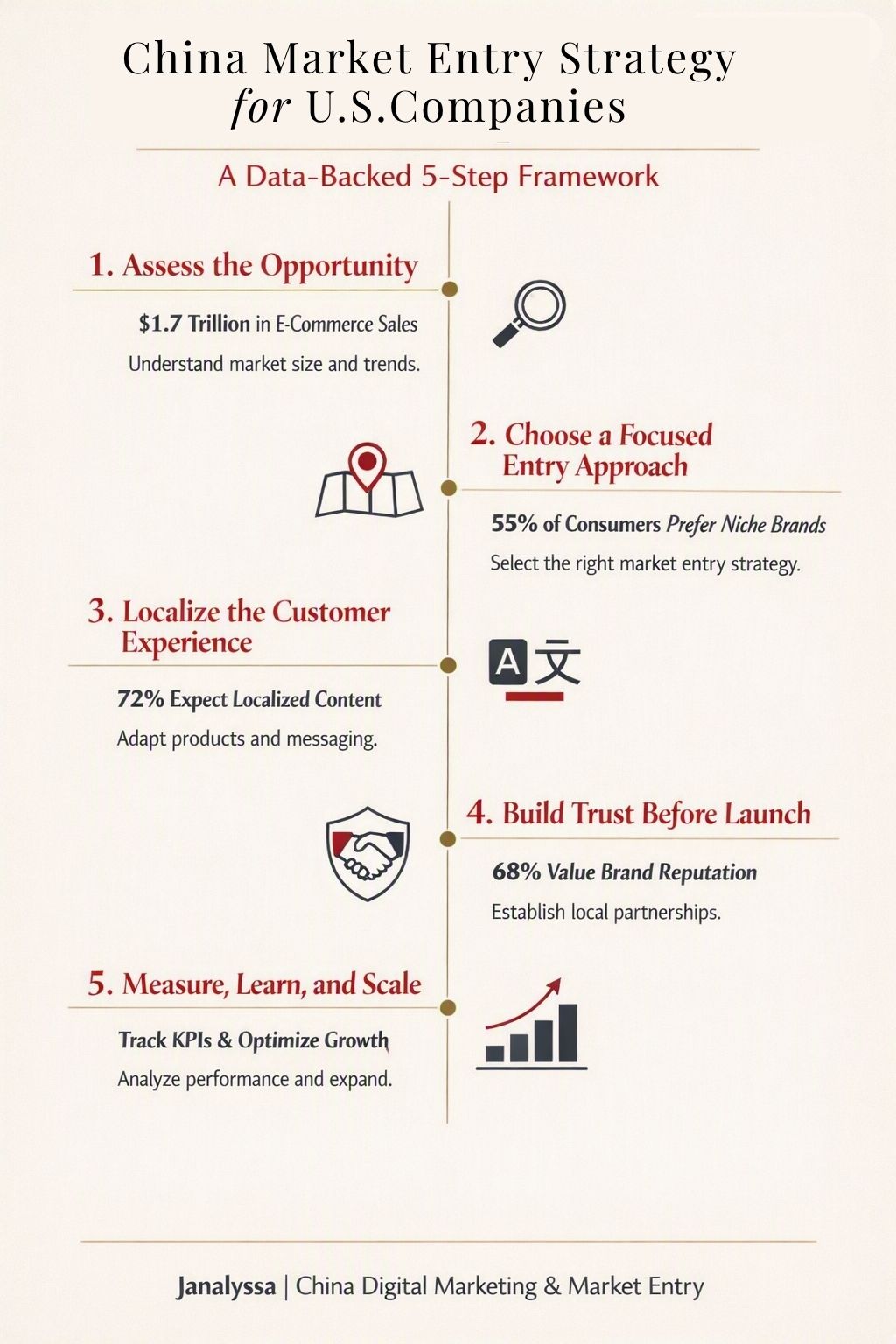
Step 1
Define your China opportunity.
Before selecting platforms or creating content, define the commercial objective behind your China expansion.
Ask:
- Who is the ideal Chinese customer for your brand?
- What need does your product or service solve?
- Which customer segment offers the best early opportunity?
- Are you seeking awareness, leads, direct sales, student inquiries, tourism bookings, or long-term brand equity?
- What does the competitive category look like in China?
- What budget, content, and operational resources can realistically support the launch?
For example, a beauty brand may prioritize skincare education, ingredient credibility, and creator reviews. A university may focus on program clarity, campus life, career outcomes, and trust signals for prospective students and families. A tourism brand may emphasize destination storytelling, local experiences, and a clear booking pathway.
Step 2
Choose the right China platforms.
You do not need to be active on every Chinese platform immediately. Start with the channels most relevant to your audience and business objective.
- RedNote / Xiaohongshu: product discovery, lifestyle content, reviews, recommendations, and consumer research.
- WeChat: ongoing communication, communities, customer relationships, and private-domain marketing.
- Douyin: short-form video, entertainment-led storytelling, creators, livestream concepts, and paid social.
- Baidu: Chinese-language search, informational content, landing pages, and brand research.
A focused launch might begin with RedNote for discovery, Baidu for search visibility, and WeChat for ongoing relationship building. The exact mix should depend on your category and customer journey.
Step 3
Localize the brand experience.
Localization is more than translation. It is the process of making your brand understandable, relevant, and credible to Chinese consumers while preserving your core identity.
A practical localization plan may include:
- Chinese-language brand messaging and website content
- Platform-native social content for RedNote, WeChat, and Douyin
- Chinese-language landing pages with clear inquiry or purchase paths
- Baidu-focused keyword and content planning
- Culturally relevant visuals, examples, and campaign concepts
- Creator briefs adapted to Chinese platform norms
- Clear customer service and follow-up processes
The objective is to make your brand feel considered and trustworthy—not like a U.S. advertisement that has been directly translated.
Step 4
Build trust with creators and communities.
Chinese consumers often rely on peer recommendations, reviews, and creator content when evaluating unfamiliar brands. This makes KOL and KOC marketing an important part of many China entry strategies.
- KOLs can help build awareness and reach larger audiences.
- KOCs can create credible reviews, tutorials, and everyday-use content.
- Category creators can provide relevance within beauty, fashion, travel, education, entertainment, or lifestyle communities.
- Longer-term partnerships can reinforce credibility beyond a one-time sponsored post.
Choose creators based on audience fit, content quality, engagement relevance, and alignment with your brand—not follower count alone.
Step 5
Measure, learn, and scale.
Treat the first phase of China marketing as a test-and-learn period. Track indicators tied to business outcomes, not just vanity metrics.
Useful measures include:
- Reach and engagement by platform
- Search visibility for branded and category terms
- Content saves, shares, comments, and profile visits
- Creator-driven traffic and referral activity
- Qualified inquiries, bookings, applications, or sales
- Cost per qualified lead or customer acquisition cost
- Repeat engagement and customer retention signals
Use early results to refine messaging, creative formats, platform priorities, and creator partnerships before expanding spend.
Common Mistakes
Avoid treating China as a translation project.
Many U.S. brands lose momentum by launching activity before they have a clear audience, platform strategy, localized customer journey, and measurement plan.
Common mistakes include:
- Treating China as a translation project rather than a market-entry strategy
- Launching on too many platforms before validating the best channel mix
- Reposting U.S. creative without adapting it for Chinese platform behavior
- Focusing on reach without building trust, reviews, and social proof
- Ignoring the customer journey after the first touchpoint
- Building a full in-house China team before validating demand
A Practical Example
A U.S. university may begin with student recruitment.
A U.S. university may not need to launch a full consumer-product campaign in China. Its first priority may be helping prospective students and families in China understand academic programs, campus life, admissions requirements, career outcomes, and the inquiry process.
In that situation, RedNote content, WeChat communication, localized landing pages, and clear inquiry pathways may be more valuable than launching across every platform at once. Learn more about China student recruitment marketing.
FAQs
Frequently asked questions.
How can a U.S. brand enter the China market?
Start by defining the target audience and business objective, researching the category and competitors, selecting priority platforms, localizing messaging and landing pages, and testing creator-led campaigns. A phased approach reduces risk and helps identify what resonates before scaling.
Which platforms should U.S. brands use in China?
The right platforms depend on the brand and objective, but common priorities include RedNote/Xiaohongshu for discovery and reviews, WeChat for relationship building, Douyin for short-form video, and Baidu for Chinese-language search.
Do U.S. brands need to translate their website for China?
Translation is only one part of localization. U.S. brands should also adapt messaging, visuals, content formats, search keywords, landing pages, and calls to action for Chinese customer expectations and platform behavior.
What is the difference between KOL and KOC marketing?
KOLs are typically larger influencers who can build awareness and reach. KOCs are usually smaller creators who generate authentic reviews, tutorials, and peer-style recommendations that can build trust.
How much does it cost to market a U.S. brand in China?
Costs vary widely based on market research, localization, platform selection, paid media, creator partnerships, and campaign scope. A phased strategy is usually more cost-effective than launching across every channel at once.
Work With Janalyssa
Ready to build your China entry strategy?
Janalyssa helps U.S. and international brands build practical China marketing strategies without the cost and complexity of creating a separate in-house team. Support can include China market entry planning, localized content, China social media strategy, RedNote and WeChat marketing, Douyin strategy, Baidu search considerations, KOL/KOC concepts, and cross-border campaign activation.
Explore Janalyssa’s China digital marketing and market entry services.
If your company is considering expansion into China, start with a focused strategy conversation rather than a scattered launch.